
Sermorelin vs HGH: GHRH Fragment vs Somatropin Compared
For laboratory research only. Not for human or animal use. This article gives no dosing, administration or therapeutic advice.
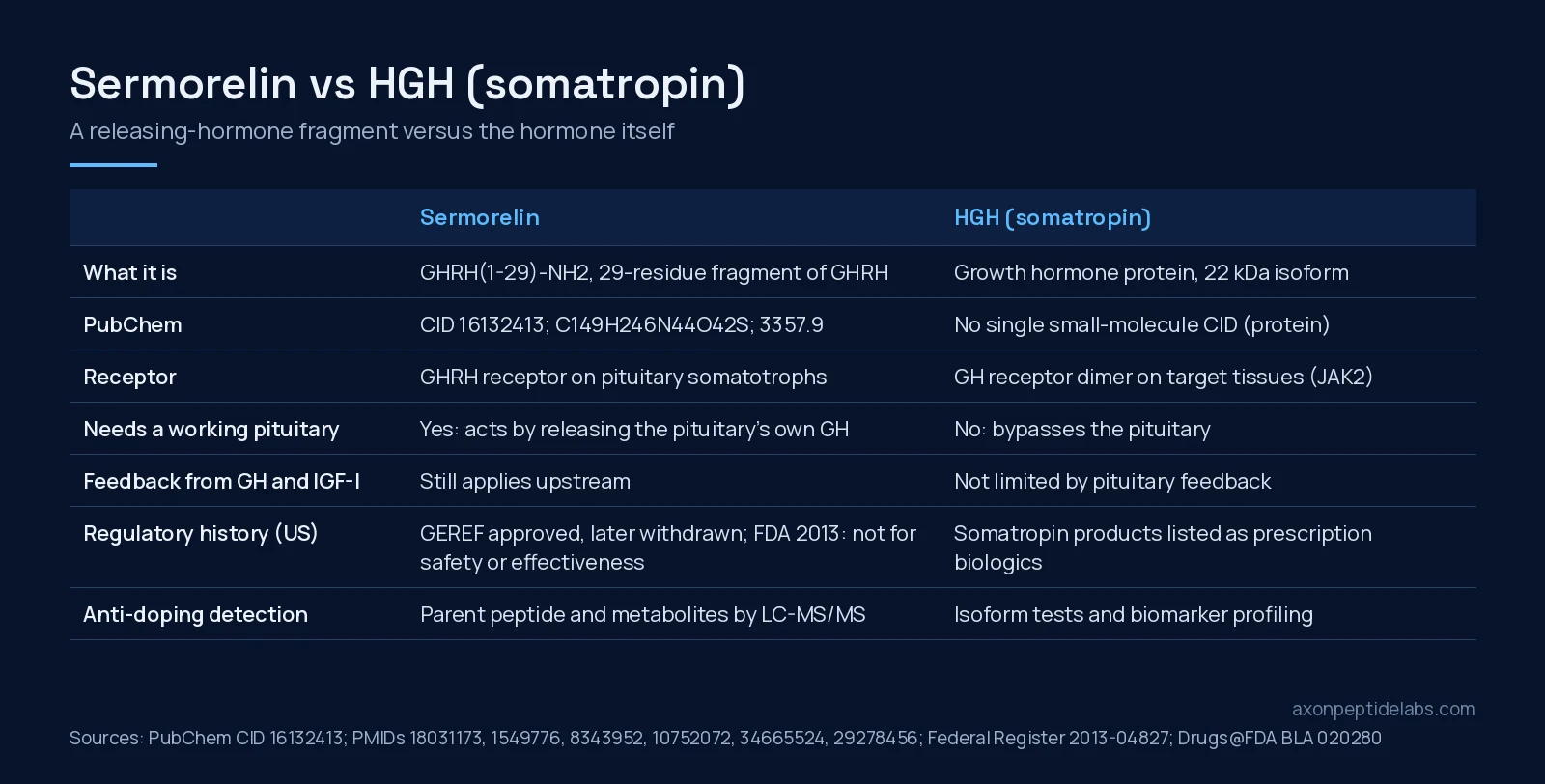
Short answer: sermorelin and HGH work at different levels of the same hormone axis. Sermorelin is GHRH(1-29)-NH2, a 29-residue fragment of growth hormone-releasing hormone; it acts on the pituitary and makes the pituitary release its own growth hormone[1][2]. HGH, or somatropin, is the growth hormone protein itself; it skips the pituitary and binds GH receptors on target tissues, which signal through the kinase JAK2[3][4]. So sermorelin depends on a working pituitary and stays inside the body’s normal feedback loops, while somatropin replaces the pituitary’s output. The two also have very different regulatory histories and are detected by completely different laboratory tests.
Identity: a 29-residue peptide versus a 22 kDa protein
Sermorelin values come from PubChem. Somatropin is a full protein with no single small-molecule PubChem compound record, so it is described by its structure papers instead.
| Field | Sermorelin | HGH (somatropin) |
|---|---|---|
| PubChem | CID 16132413 | No single small-molecule CID (protein) |
| Synonyms (PubChem) | hGHRH(1-29)NH2, Groliberin, CAS 86168-78-7 | Human growth hormone, rhGH |
| Molecular formula | C149H246N44O42S | Not applicable (protein) |
| Size | 3357.9 g/mol, 29 residues, C-terminal amide[2] | Main circulating isoform about 22 kDa; a 20 kDa isoform also exists[5] |
| Fold | Short linear peptide; N-terminal region carries most receptor activity[6] | Four-helix bundle that binds two receptor molecules[3] |
| Sequence (sermorelin) | YADAIFTNSYRKVLGQLSARKLLQDIMSR-NH2 | — |
The size gap is large. Sermorelin is a small peptide; somatropin is a recombinant protein that, in its receptor complex, binds one hormone molecule to two receptor molecules[3]. A certificate for one could never describe the other, and the two are not interchangeable in any assay.
Where each one acts
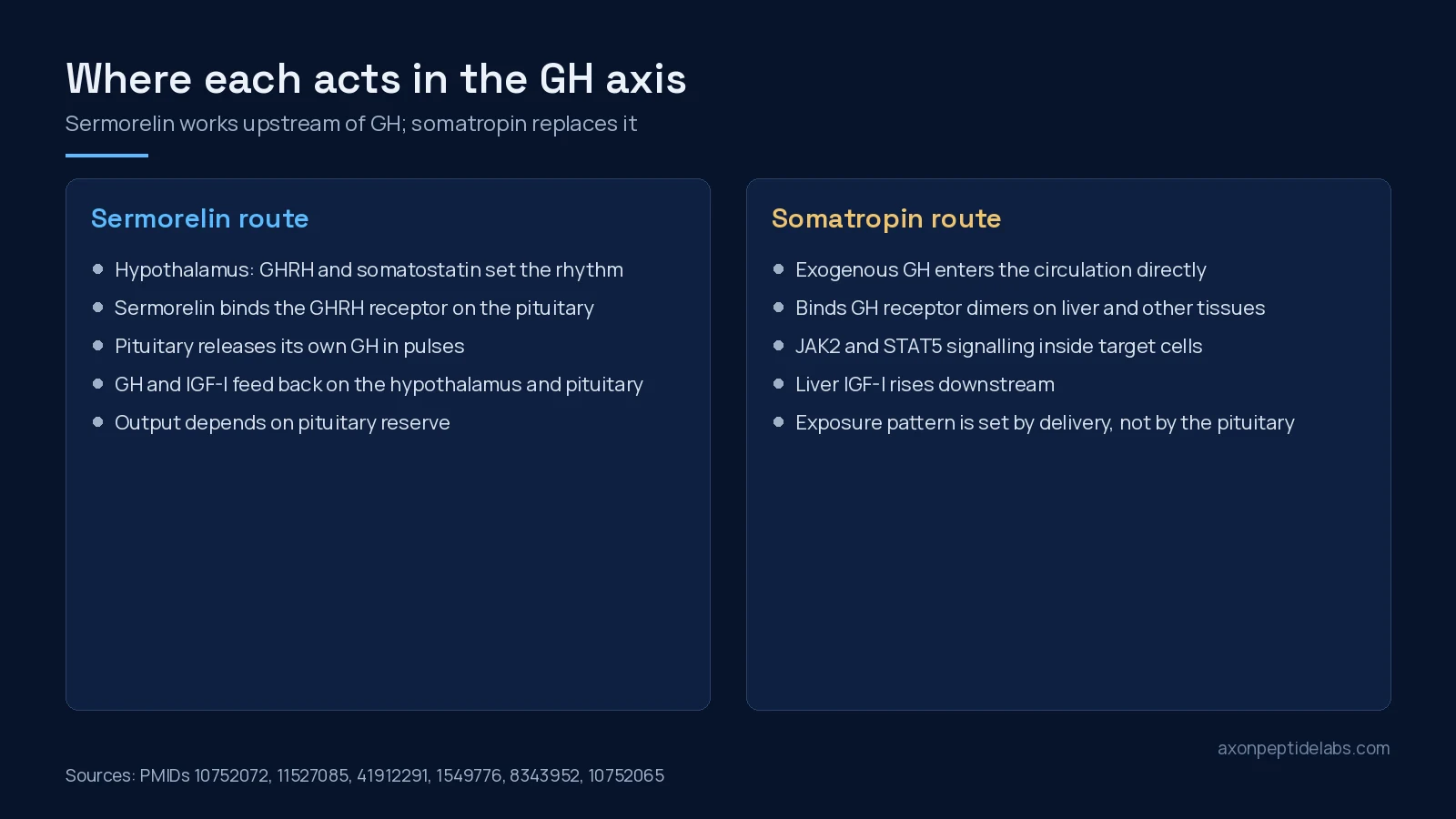
Growth hormone leaves the pituitary in short, sharp bursts rather than a steady stream. That pattern is set by two opposing hypothalamic signals: GHRH, which drives release, and somatostatin, which restrains it. These factors also control GH synthesis and the pituitary’s secretory reserve, and GH output is sensitive to feedback from GH itself and from IGF-I[7][8]. A 2026 review describes the same arrangement, with ghrelin as a third input and negative feedback from GH and IGF-I[9].
Sermorelin plugs into the top of this system. It is the shortest synthetic peptide with the full biological activity of GHRH, and it specifically stimulates GH secretion from the anterior pituitary[1]. Early structure work showed why the fragment works: shortened GHRH amides down to residues 1-29 kept about half the potency of the full hormone on rat pituitary cells, and activity only disappeared when the chain was cut to residues 1-19[2]. Because it works through the pituitary, sermorelin can only release GH that the pituitary is able to make.
Somatropin enters at the bottom. GH binds its receptor on target cells, the receptor associates with the tyrosine kinase JAK2, and JAK2 activation starts the intracellular signal[4]. In the liver, that signal runs largely through STAT5 proteins[10]. For a closer look at what happens downstream, including IGF-1, see our IGF-1 LR3 vs HGH comparison.
Why the pattern of GH exposure matters
The most important research difference between the two may be timing rather than amount. In rats, pituitary GH is released intermittently in males and almost continuously in females, and that pattern alone changes which genes the liver switches on[10][11]. Intermittent GH pulses repeatedly triggered tyrosine phosphorylation and nuclear entry of the liver transcription factor STAT5b in male rats, while continuous GH exposure led to desensitisation and a sharp fall in nuclear STAT5b[12]. When STAT5b was knocked out in mice, male-specific liver gene expression dropped to female levels[10].
The same rat work found that sex-typical liver steroid metabolism persisted even when pituitary GH was cut by about 95%, which suggests the shape of the signal can matter as much as its size[11]. Peripheral responses to GH depend strongly on the pattern of exposure[7]. This is why the comparison is not simply “stimulate GH” versus “add GH”: a releasing-hormone analogue acts through the pituitary’s own rhythm and its somatostatin restraint, while exogenous somatropin produces an exposure profile set by how it is delivered. Researchers choosing between them are, in effect, choosing between two different exposure patterns.
Side-by-side comparison
| Aspect | Sermorelin | HGH (somatropin) |
|---|---|---|
| Level of the axis | Pituitary (GHRH receptor)[1] | Peripheral GH receptor[3] |
| Requires functioning somatotrophs | Yes; a normal response cannot exclude a hypothalamic cause of GH deficiency[1] | No |
| Subject to somatostatin and GH/IGF-I feedback | Yes, as part of pituitary GH release[7][8] | Exogenous levels are set by delivery; feedback acts on the pituitary’s own output[7] |
| Half-life issue | Short half-life limited clinical use of GHRH(1-29); a PEG-conjugated GHRH was developed to address it[13] | Not the main research variable |
| Historic clinical use | Diagnostic test of pituitary GH reserve in children[1] | Prescription biologic (Drugs@FDA, application 020280) |
| Doping-control approach | LC-MS/MS of the parent peptide and metabolites such as sermorelin(3-29)-NH2[14][15] | Isoform-differential tests and biomarker profiles (IGF-1, P-III-NP)[5][16] |
Regulatory status, stated plainly
Sermorelin acetate was once an approved US drug under the name GEREF. In 2013 the FDA published a determination that the GEREF products were not withdrawn from sale for reasons of safety or effectiveness (Federal Register, March 4, 2013). It is no longer marketed under that name. Somatropin, by contrast, is a currently listed prescription product: Drugs@FDA shows Genotropin (somatropin) under application 020280, which was deemed a biologics licence application on March 23, 2020 (Drugs@FDA, application 020280). Neither fact says anything about research-grade material, and we make no claims about the legal status of either product in Canada.
How laboratories tell them apart
Anti-doping science gives a useful picture of how differently the two behave as analytes. GHRH and its analogues are prohibited by the World Anti-Doping Agency; one study identified 19 in vitro metabolites of four GHRH analogues, including sermorelin, and used them as reference materials in urine[14]. A validated triple-quadrupole UHPLC-MS/MS method detects sermorelin and its metabolite sermorelin(3-29)-NH2 alongside other GHRHs[15].
Somatropin is harder, because it is identical in sequence to the body’s own 22 kDa GH. Testing therefore looks at the ratio of GH isoforms: exogenous recombinant GH raises the 22 kDa fraction relative to other isoforms, and an antibody-free mass spectrometry method was developed to confirm the antibody-based isoform test[5]. A second route profiles downstream markers, IGF-1 and procollagen III peptide, over time, using the Athlete Biological Passport approach[16].
What the evidence does not show
- No head-to-head research comparison. We found no study that compares research-grade sermorelin and somatropin in the same model with the same endpoints.
- GH in healthy people is not a performance or anti-aging tool in the literature. A systematic review of randomised trials in healthy elderly people concluded that GH was associated with small body-composition changes and more adverse events, and could not be recommended as an anti-aging therapy[17]. A review of trials in young, fit people found that claims of improved athletic performance were not supported[18].
- Much sermorelin literature is old or pediatric. Its best-characterised use was as a diagnostic test in children[1], and an often-cited adult paper is a narrative review rather than new trial data[19].
- Rat liver data are a model. The pulse-pattern findings come from rats and knockout mice and show a mechanism, not an outcome in any other species.
Documentation for our listings
We list Sermorelin 10mg and HGH 20iu for laboratory research. No certificate is posted for either product on our COA page at the time of writing. For how sermorelin compares with the full-length GHRH analogue tesamorelin, see Tesamorelin vs Sermorelin; our sermorelin Canada page covers the product itself. You can also buy lab-tested peptides in Canada through our main catalogue.
Frequently asked questions
Frequently asked questions
Is sermorelin a form of HGH?
No. Sermorelin is GHRH(1-29)-NH2, a 29-residue fragment of growth hormone-releasing hormone with a PubChem molecular weight of 3357.9. HGH (somatropin) is the growth hormone protein itself, mainly a 22 kDa isoform. Sermorelin acts on the pituitary; somatropin acts on GH receptors in target tissues.
Why does sermorelin need a functioning pituitary?
Sermorelin works by binding the GHRH receptor on pituitary somatotrophs, which then release their own growth hormone. If the pituitary cannot make GH, there is nothing for sermorelin to release. Somatropin bypasses this step entirely.
Why does the pattern of GH exposure matter in research?
In rats, intermittent GH pulses repeatedly activated the liver transcription factor STAT5b, while continuous exposure desensitised it, and this pattern controls sex-specific liver gene expression. A releasing hormone works through the pituitary’s own pulsatile rhythm; exogenous somatropin gives an exposure pattern set by delivery.
Was sermorelin ever an approved drug?
Yes. Sermorelin acetate was approved in the US as GEREF. In March 2013 the FDA published a determination that the GEREF products were not withdrawn from sale for reasons of safety or effectiveness.
How do anti-doping labs detect sermorelin versus HGH?
Sermorelin and its metabolite sermorelin(3-29)-NH2 can be measured directly by LC-MS/MS. Recombinant HGH matches the body’s own 22 kDa GH, so labs use GH isoform ratios and longitudinal biomarker profiles such as IGF-1 and procollagen III peptide.
Does Axon Peptide Labs post a COA for Sermorelin or HGH?
No certificate is posted for Sermorelin 10mg or HGH 20iu on our COA page at the time of writing.
References
- Prakash A, Goa KL (1999). Sermorelin: a review of its use in the diagnosis and treatment of children with idiopathic growth hormone deficiency. BioDrugs. PMID: 18031173. doi: 10.2165/00063030-199912020-00007.
- Ling N, Baird A, Wehrenberg WB et al. (1984). Synthesis and in vitro bioactivity of C-terminal deleted analogs of human growth hormone-releasing factor. Biochem Biophys Res Commun. PMID: 6435620. doi: 10.1016/0006-291x(84)90309-7.
- de Vos AM, Ultsch M, Kossiakoff AA (1992). Human growth hormone and extracellular domain of its receptor: crystal structure of the complex. Science. PMID: 1549776. doi: 10.1126/science.1549776.
- Argetsinger LS, Campbell GS, Yang X et al. (1993). Identification of JAK2 as a growth hormone receptor-associated tyrosine kinase. Cell. PMID: 8343952. doi: 10.1016/0092-8674(93)90415-m.
- Arsene C, Schulze D, Röthke A et al. (2018). Growth hormone isoform-differential mass spectrometry for doping control purposes. Drug Test Anal. PMID: 29278456. doi: 10.1002/dta.2350.
- Cervini LA, Donaldson CJ, Koerber SC et al. (1998). Human growth hormone-releasing hormone hGHRH(1-29)-NH2: systematic structure-activity relationship studies. J Med Chem. PMID: 9513600. doi: 10.1021/jm970618s.
- Robinson IC (2000). Control of growth hormone (GH) release by GH secretagogues. Novartis Found Symp. PMID: 10752072.
- Veldhuis JD, Anderson SM, Shah N et al. (2001). Neurophysiological regulation and target-tissue impact of the pulsatile mode of growth hormone secretion in the human. Growth Horm IGF Res. PMID: 11527085. doi: 10.1016/s1096-6374(01)80005-8.
- Iglesias P, Guerrero-Pérez F (2026). Growth hormone: Synthesis and regulation. Vitam Horm. PMID: 41912291. doi: 10.1016/bs.vh.2025.10.001.
- Waxman DJ (2000). Growth hormone pulse-activated STAT5 signalling: a unique regulatory mechanism governing sexual dimorphism of liver gene expression. Novartis Found Symp. PMID: 10752065. doi: 10.1002/0470870796.ch5.
- Legraverend C, Mode A, Wells T et al. (1992). Hepatic steroid hydroxylating enzymes are controlled by the sexually dimorphic pattern of growth hormone secretion in normal and dwarf rats. FASEB J. PMID: 1537461. doi: 10.1096/fasebj.6.2.1537461.
- Waxman DJ, Ram PA, Park SH et al. (1995). Intermittent plasma growth hormone triggers tyrosine phosphorylation and nuclear translocation of a liver-expressed, Stat 5-related DNA binding protein. Proposed role as an intracellular regulator of male-specific liver gene transcription. J Biol Chem. PMID: 7768925. doi: 10.1074/jbc.270.22.13262.
- Munafo A, Nguyen TX, Papasouliotis O et al. (2005). Polyethylene glycol-conjugated growth hormone-releasing hormone is long acting and stimulates GH in healthy young and elderly subjects. Eur J Endocrinol. PMID: 16061831. doi: 10.1530/eje.1.01965.
- Memdouh S, Gavrilović I, Ng K et al. (2021). Advances in the detection of growth hormone releasing hormone synthetic analogs. Drug Test Anal. PMID: 34665524. doi: 10.1002/dta.3183.
- Cristea CD, Radu M, Toboc A et al. (2023). Cationic exchange SPE combined with triple quadrupole UHPLC-MS/MS for detection of GHRHs in urine samples. Anal Biochem. PMID: 37806509. doi: 10.1016/j.ab.2023.115336.
- Equey T, Pastor A, de la Torre Fornell R et al. (2022). Application of the Athlete Biological Passport Approach to the Detection of Growth Hormone Doping. J Clin Endocrinol Metab. PMID: 34726230. doi: 10.1210/clinem/dgab799.
- Liu H, Bravata DM, Olkin I et al. (2007). Systematic review: the safety and efficacy of growth hormone in the healthy elderly. Ann Intern Med. PMID: 17227934. doi: 10.7326/0003-4819-146-2-200701160-00005.
- Liu H, Bravata DM, Olkin I et al. (2008). Systematic review: the effects of growth hormone on athletic performance. Ann Intern Med. PMID: 18347346. doi: 10.7326/0003-4819-148-10-200805200-00215.
- Walker RF (2006). Sermorelin: a better approach to management of adult-onset growth hormone insufficiency?. Clin Interv Aging. PMID: 18046908. doi: 10.2147/ciia.2006.1.4.307.